Why the Wins Aren't Enough
Prosperity Is Something You Become™
The scarcity pattern that survives success— and what to do about it
You've hit goals that used to feel out of reach.
The income is there. The business is real. The credentials, the reputation, the track record — you've built something that most people around you would consider successful.
And yet there's a quiet voice underneath all of it.
It's not enough yet.
Someone else is further ahead.
One bad quarter and this could all shift.
I can't afford to slow down.
You don't talk about it much. It doesn't fit the image of the leader you've built. But if you're honest, that voice has been running in the background for a long time — maybe longer than the success has.
Here's what that voice actually is.
It's not ambition. It's not healthy drive. It's not discernment.
It's scarcity. And it didn't leave when the results arrived.
Scarcity Is Not About What You Have
The most important thing to understand about scarcity is this:
It is not a financial condition. It is a perceptual one.
Scarcity is a pattern of thinking that keeps attention locked on what is missing rather than what is present. And it is entirely possible — common, even among high achievers — to carry that pattern straight through every level of external success without ever examining it.
You can increase your income and still worry constantly about losing it.
You can hit a significant milestone and feel behind before the week is out.
You can build a business that objectively works and still operate from a quiet, persistent fear that it's not sustainable.
When that happens, the problem is not the circumstance. The circumstance improved. The problem is the pattern — and patterns don't self-correct just because the environment changes.
How Scarcity Hides in High Performers
Scarcity rarely shows up as obvious lack in someone who has already achieved real results. It's more subtle than that. In high performers, it tends to look like this:
You're constantly comparing your position to someone who appears to be further ahead — and the comparison always lands the same way. They're winning. You're catching up.
Progress feels invisible. You can name what still needs to happen far more easily than you can name what already has.
Opportunity creates hesitation rather than energy. There's always a reason it might not work, a risk that outweighs the possibility, a voice that says not yet.
You're overworking — not because the work demands it, but because stopping feels dangerous. As if the results are contingent on never letting up.
None of this feels like scarcity from the inside. From the inside, it feels like high standards. Like responsibility. Like being realistic.
But there's a difference between high standards and operating from fear. And most high performers I work with know the difference — they just haven't named it yet.
The Loop That Keeps It Running
Scarcity follows a pattern that self-reinforces over time:
A thought forms around lack or threat. That thought generates fear. Fear causes contraction — a narrowing of perspective, a retreat from risk, a tightening of decision-making. Contraction produces hesitation. Hesitation limits results. And limited results confirm the original thought.
The loop repeats.
What makes this pattern so persistent is that over time, the individual stops experiencing it as a thought pattern and starts experiencing it as reality. Limitation stops feeling like a perspective and starts feeling like the truth about what's possible.
That's when scarcity becomes structural — not just a passing worry, but a foundational assumption that quietly shapes every decision, every goal, and every standard you're willing to hold for yourself.
Prosperity Is Something You Become
At Total MindPower Institute, we teach a principle that reorients how high performers think about this entirely:
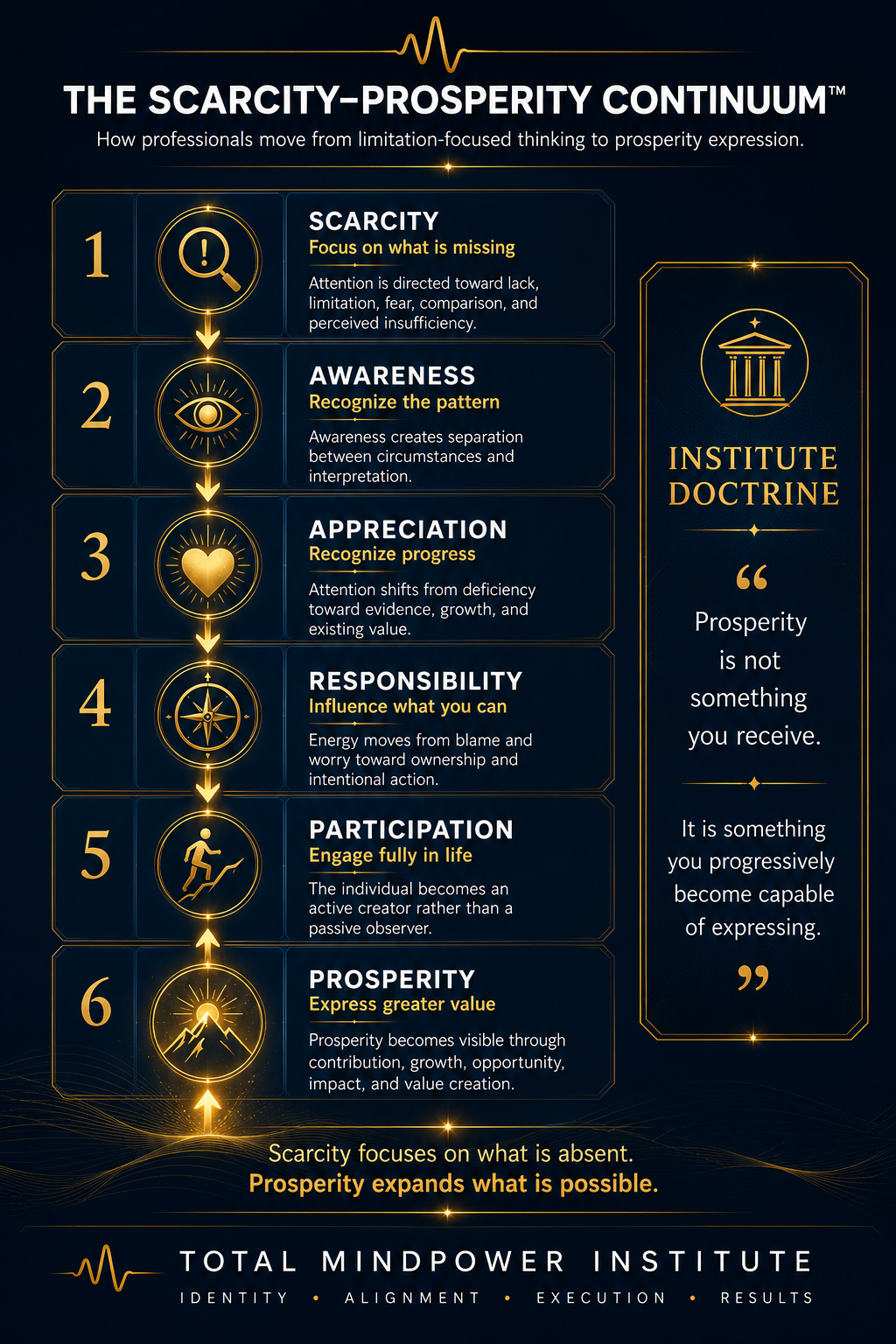
Prosperity is not something you receive. It is something you progressively become capable of expressing.
That distinction matters more than it might first appear.
If prosperity is something you receive, you remain dependent on external conditions — the economy, the market, the client, the opportunity. You're always waiting for circumstances to confirm that you're allowed to feel secure.
But if prosperity is something you become, the internal shift precedes the external result. You don't wait for the environment to change. You change first — in how you think, what you focus on, what you expect, what you're willing to participate in.
The earliest signs of that shift don't look dramatic. They look like this:
Greater self-trust in decisions you used to second-guess. A willingness to acknowledge progress rather than moving past it. Elevated standards that come from confidence rather than fear. A sense of direction that reduces the grip of comparison because you're clear on where you're going and why.
These are not outcomes. They're indicators. Prosperity becoming visible internally before it compounds externally.
Five Ways to Interrupt the Pattern
Awareness is where every meaningful shift begins. But awareness alone doesn't break the loop. Here's what does:
Notice where your attention actually lives. Not where you intend it to go — where it goes on its own. Attention amplifies experience. If yours defaults to what's missing, that's what gets magnified. The question isn't what you want to focus on. It's what you're actually focused on, most of the time.
Build a daily evidence practice. Scarcity focuses on distance — how far you still have to go. Prosperity notices movement — how far you've already come. At the end of each day, document three specific pieces of evidence that things are working, building, or progressing. Do it even when it feels forced. Especially then.
Use gratitude as a performance tool, not a platitude. Gratitude practiced intentionally shifts the brain's filtering system from deficiency to sufficiency. This is not about denying what's hard. It's about refusing to let what's hard be the only thing that registers.
Expand your sense of responsibility. Scarcity contracts. It narrows focus to protection and survival. Prosperity expands. Ask yourself: what can I actually influence right now? Then move in that direction. Participation builds momentum — and momentum disrupts the scarcity loop faster than thinking about it ever will.
Anchor to a directional identity. People who are clear on who they are becoming and where they are going experience comparison less, fear less, and hesitate less. Not because external certainty increases, but because internal orientation stabilizes. Direction reduces the grip of scarcity more reliably than any mindset exercise.
The Honest Question
Scarcity doesn't announce itself. It disguises itself as practicality, caution, ambition, and high standards.
So before you move past this — sit with it for a moment.
Where is scarcity currently influencing your thinking — not because resources are absent, but because your attention is still locked on what's missing?
And more importantly:
What evidence already exists that prosperity is emerging — that you've been moving past without stopping to register it?
Because the pattern that got you here was built over years.
The pattern that takes you to the next level requires the same investment.
It starts with noticing what's already true.
— E
Total MindPower Institute
Identity – Alignment – Execution – Results
Directional Identity Diagnostic
If you feel capable of more than your current results reflect, the Directional Identity Diagnostic can help you identify where greater clarity and alignment may be needed.
This complimentary assessment evaluates the relationship between your identity, direction, and execution to help uncover the patterns influencing your current results.
Next Step
Complete the Directional Identity Diagnostic and gain greater clarity about the next stage of your growth.
About the MindPower Journal
The MindPower Journal is the applied thinking publication of Total MindPower Institute.
It exists to help professionals build identity-aligned clarity, disciplined execution, and meaningful results through structured thinking and practical insight.