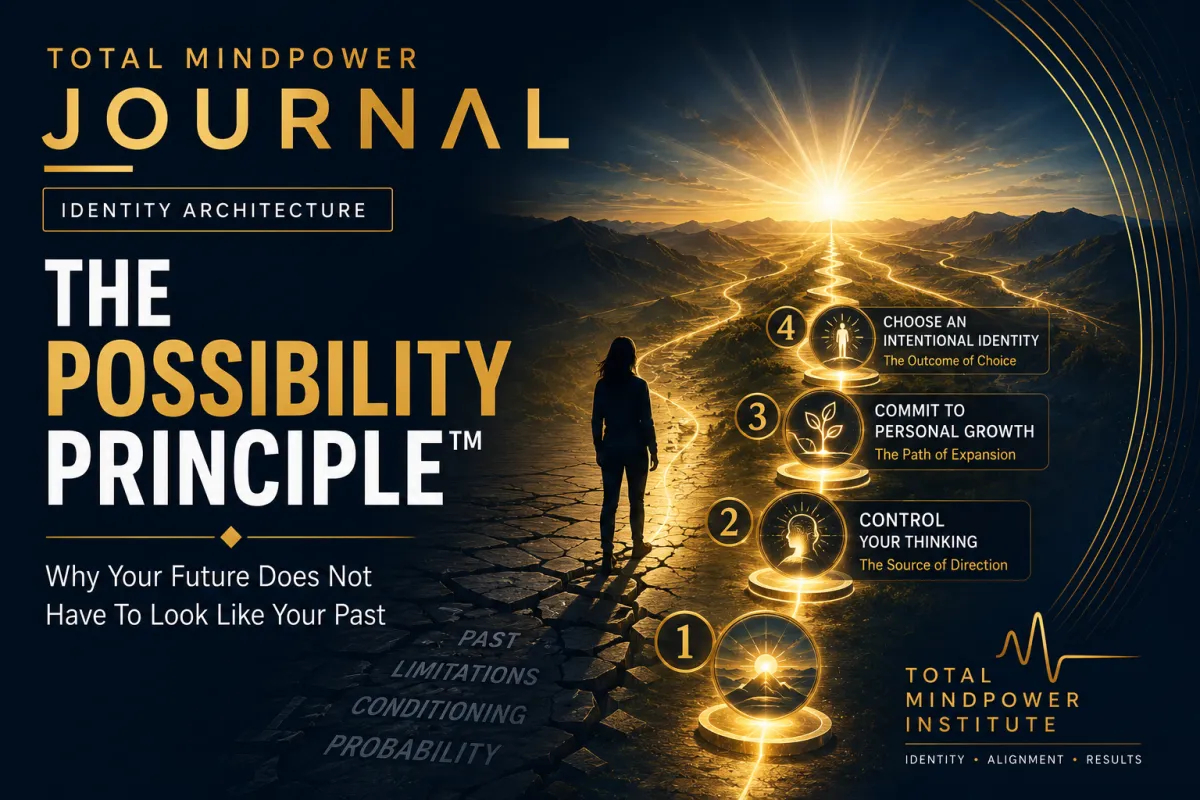
The Possibility Principle™: The Foundational Philosophy of Total MindPower
The Possibility Principle™
Why Your Future Doesn't Have to Look Like Your Past
There is a moment most high achievers recognize when they hear it described.
It doesn't happen during failure. It happens during success — or what looks like success from the outside.
You've built something real. The results are there. And yet at some point, without fully noticing when it happened, you started making decisions based on what your history suggests is possible rather than what your potential actually is.
You stopped pitching for the larger client. Not because you couldn't serve them — because part of you quietly decided that wasn't your lane.
You pulled back from the bigger goal. Not because the goal was wrong — because the evidence from your past made it feel presumptuous.
You kept the ceiling where it was. Not because the ceiling was real — because you'd been living beneath it long enough that it started feeling like the floor.
This is not a motivation problem. This is not a discipline problem. This is what happens when a capable person unconsciously allows their current circumstances and past results to define what they believe is possible for them going forward.
And it is the single most common pattern I see in professionals who are genuinely capable of more.
The Possibility Principle™ exists to interrupt that pattern at the root.
What the Possibility Principle Actually Claims
Let me be direct about what this philosophy does and does not say — because it is frequently misunderstood.
The Possibility Principle does not claim that every outcome is guaranteed.
It does not promise that desire equals results, or that thinking differently will instantly change your circumstances.
What it asserts is more precise — and more powerful:
Your current circumstances are not permanent. And your interpretation of those circumstances is not reality.
Most people do not suffer from a lack of potential. They suffer from a lack of perceived possibility. And that distinction matters more than almost anything else I teach, because the sequence it creates determines everything that follows.
Before a person changes behavior, they must believe change is possible.
Before they pursue a meaningful goal, they must believe it is attainable for them — not theoretically, not for other people, but for them specifically.
Before they become someone different, they must first be willing to consider that a different version of themselves can exist.
Possibility always precedes progress.
Not as inspiration. As mechanism.
The moment you expand what you believe is possible, awareness expands with it. When awareness expands, you begin seeing choices you couldn't see before. When choices expand, behavior begins to shift. When behavior shifts, results change. And when results change, identity begins to update.
Everything starts with the willingness to consider a new possibility.
That willingness is not a feeling. It is a decision.
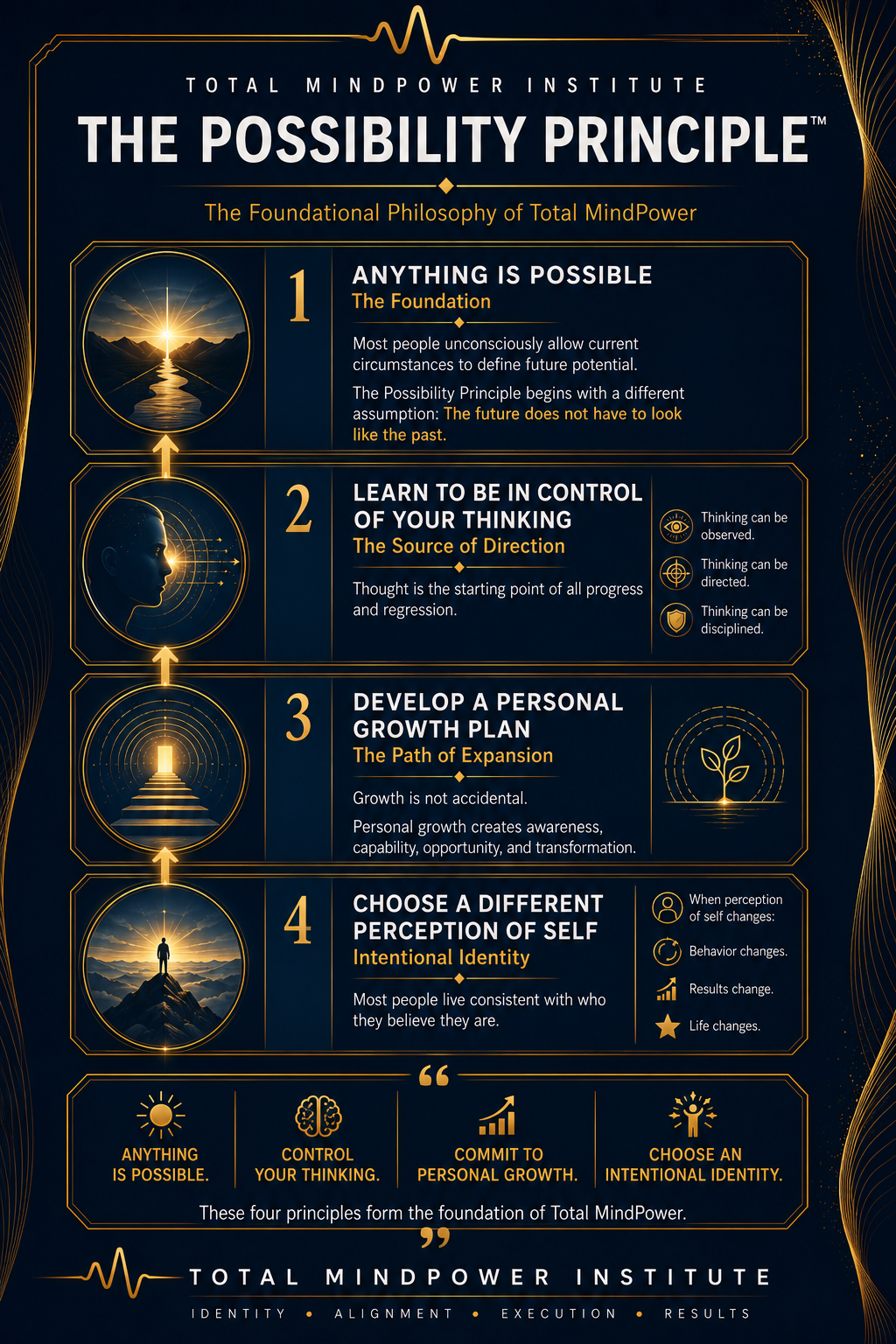
Principle One: Anything Is Possible
History does not argue with this principle — it demonstrates it, repeatedly, across every domain of human achievement.
Every meaningful result that exists today was once considered impossible by someone. Not by optimists or dreamers. By serious, educated, experienced people who looked at the evidence available and concluded it couldn't be done.
The evidence was real. The conclusion was wrong.
What the evidence actually demonstrated was the limit of what had been done before — not the limit of what was possible.
This is the distinction that changes everything for the high achiever at plateau.
When you look at your current results and conclude that they define the ceiling of your potential, you are doing what those serious, educated people did. You are confusing the record of what has happened with the boundary of what can happen.
Current circumstances are data. They are not destiny.
The moment you genuinely open to the possibility that something different is available — that the plateau is a perceptual condition, not a permanent one — something in how you engage with your situation begins to shift.
You don't need certainty. You need willingness.
Willingness is where everything begins.
Principle Two: Learn to Be in Control of Your Thinking
If possibility is the foundation, thought is the construction site.
Every result you have produced in your life began as a thought. Every limitation you are currently experiencing began as a thought. The income ceiling. The hesitation before the big ask. The pattern of almost — almost closing it, almost making the leap, almost committing fully to the next level.
All of it began in thought before it became behavior.
Most people spend their entire lives observing circumstances and reacting to them. They experience the results of their thinking without ever examining the thinking itself. The thought arrives, generates an emotion, the emotion drives a behavior, the behavior produces a result — and the person believes they are responding to life when in reality they are responding to a mental program that has been running largely unexamined for years.
Personal growth begins the moment you turn attention from circumstances to the thoughts that are interpreting those circumstances.
Here is what most high performers discover when they first do this honestly:
A significant portion of the thinking driving their current results was not consciously chosen. It was inherited — from early experience, from environment, from the stories they told themselves about what early setbacks meant, from the identity conclusions they reached before they had the wisdom to question them.
Thought can be observed.
Thought can be directed.
Thought can be disciplined toward a chosen future rather than defaulting toward a familiar past.
This is not a soft skill. This is the foundational competency beneath every other capability you have built. Because when your thinking changes at the level of identity — when what you believe about yourself, what's possible, and what you deserve begins to shift — everything built on top of that changes with it.
Controlling your thinking is not about suppressing doubt or performing positivity.
It is about learning to direct the most powerful instrument available to you.
Principle Three: Commit to a Personal Growth Plan
Growth is not what happens when circumstances are favorable.
Growth is what happens when a person intentionally places themselves into environments, relationships, and disciplines that challenge the current version of who they are.
The most successful people I have worked with share one consistent characteristic — not talent, not timing, not opportunity. Intentionality about growth. They made a committed decision that who they were at any given moment was not the final answer. That the identity producing current results was a starting point, not a ceiling.
That decision changes how you allocate time. It changes who you invest in relationships with. It changes what you read, what you study, what conversations you seek out, what discomfort you are willing to tolerate.
Without intentional growth, potential remains dormant.
The capability is there. The insight is there. But without the commitment to consistently place yourself at the edge of your current identity — where growth actually happens — potential stays theoretical.
Growth is not accidental.
Expansion is the natural consequence of intentional development.
Growth is the bridge between possibility and realization.
A growth plan is not a reading list or a course calendar. It is a committed orientation toward becoming — a decision that you are not finished, that you are building something, and that the person you are becoming is worth the investment of consistent, intentional development.
That orientation is what separates people who plateau from people who compound.
Principle Four: Choose a Different Perception of Self
This is where everything converges.
The first three principles — expanding possibility, directing thought, committing to growth — all exist in service of this one.
Because ultimately, results do not change until identity changes.
You will not consistently produce results that exceed your identity. Not because of lack of effort. Because the human system is extraordinarily effective at maintaining congruence between who a person believes they are and what their life actually looks like. We make unconscious decisions every day that keep our external world aligned with our internal self-concept.
The executive who believes they are a person who figures things out — figures things out. The professional who believes they are someone success happens to other people — finds evidence for that everywhere. Not because the world is arranged that way. Because identity is a filter that determines what we notice, what we pursue, and what we allow ourselves to receive.
This is the most important thing I teach.
Identity is not fixed. It is chosen.
Not once. Consistently, over time, through the repeated decisions about who you intend to become and what that person does, thinks, believes, and expects.
When identity shifts — genuinely shifts, not as affirmation but as a committed internal decision — behavior follows without requiring the same level of willpower. Standards rise naturally. Decisions align more consistently with the future being built rather than the past being protected.
The greatest transformation available to you is not a new strategy or a better system.
It is the conscious decision to become a different version of yourself — and the willingness to let that decision organize everything that follows.
That is not a motivational statement.
That is how change actually works.
Why These Four Principles Form a System
Possibility without directed thought remains wishful.
Directed thought without growth commitment remains intellectual.
Growth without identity shift produces temporary change that reverts under pressure.
But when a person genuinely expands what they believe is possible, takes deliberate control of their thinking, commits to intentional growth, and chooses — consciously, repeatedly — a different perception of themselves:
New results become not just possible. They become inevitable.
This is the foundational philosophy of Total MindPower Institute. Not a motivational framework. Not a self-help doctrine.
A practical philosophy built on a single premise: the future does not have to look like the past — and the distance between where you are and where you are capable of going is determined not by your circumstances, but by what you are willing to believe is possible, how deliberately you direct your thinking, how committed you are to growth, and who you decide to become.
Every framework we teach, every tool we offer, every conversation we have returns to these four ideas.
Because every meaningful transformation begins with the same first move.
A person becomes willing to consider a new possibility.
The Question Worth Sitting With
Before you move forward — take a moment with this:
Not what you've said publicly.
What you've privately decided isn't for you.
What you've pulled back from without fully acknowledging that you pulled back.
That answer is where the work begins.
Ready to Identify Where the Gap Actually Is?
If you recognize yourself in this — if you know you're capable of more but aren't certain where identity, thinking, or direction may be out of alignment — the Directional Identity Diagnostic was built for exactly this moment.
It identifies the specific patterns influencing your direction, thinking, standards, execution, and identity — so you can create the clarity and momentum your current level of capability deserves.
Take the Directional Identity Diagnostic → and gain greater clarity about the next stage of your growth.
My purpose is simple: to wake people up to possibility.
Because every meaningful transformation begins when a person becomes willing to consider that their future does not have to look like their past.
— E
Total MindPower Institute
Identity – Alignment – Execution – Results
About the MindPower Journal
The MindPower Journal is the applied thinking publication of Total MindPower Institute.
It exists to help professionals build identity-aligned clarity, disciplined execution, and meaningful results through structured thinking and practical insight.