Your Vision Is Not a Thinking Problem
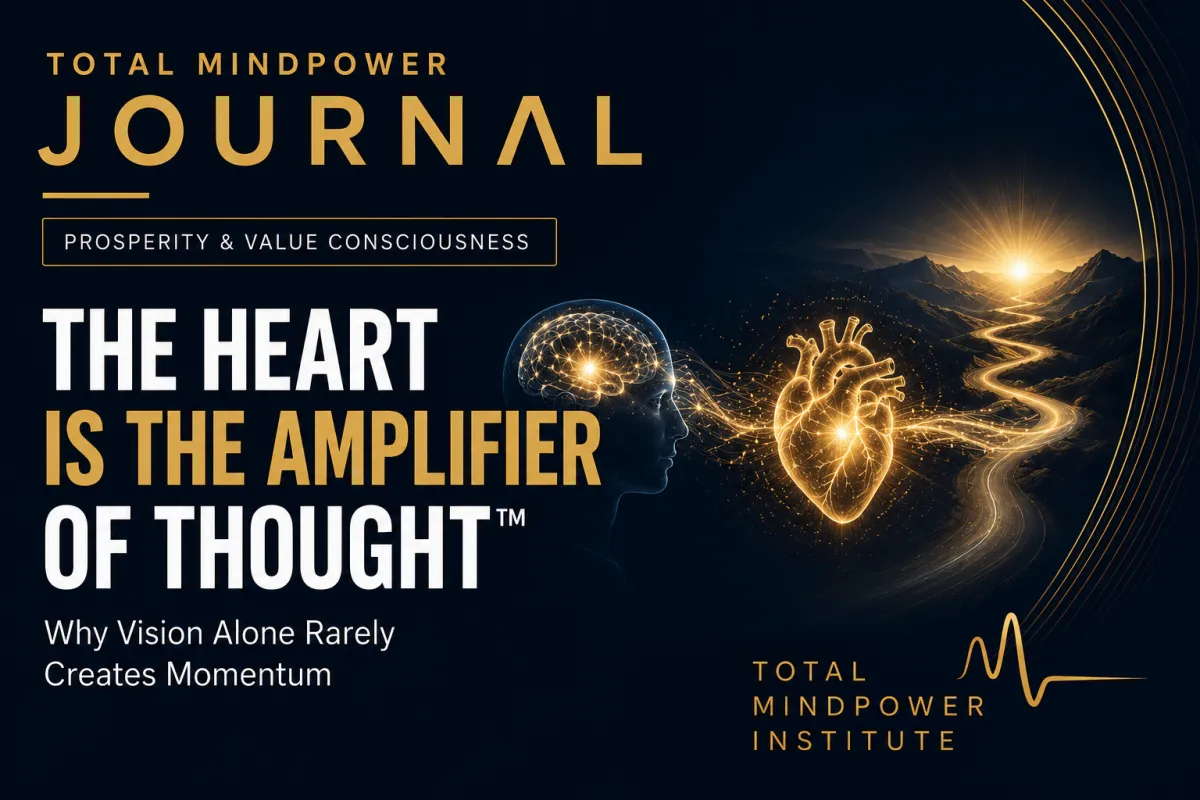
The Heart Is the Amplifier of Thought™
Why vision alone rarely creates momentum
You can describe your vision with precision.
You know the income level. The kind of leader you want to be. The business you're building. The life on the other side of the next stage of growth.
You can articulate it clearly. You've thought about it extensively. You may have written it down, mapped it out, shared it with people you trust.
And yet — it isn't moving the way it should.
Not because the vision is wrong.
Not because you lack the capability to execute it.
But because there's a gap most high performers never think to examine.
The vision lives in the mind. But momentum requires something the mind alone cannot supply.
The Part of the Formula Nobody Talks About
High achievers are exceptionally good at the cognitive work of performance.
Setting goals. Building systems. Analyzing gaps. Solving problems. Identifying the next move.
The mind is a precision instrument — and you've spent years sharpening yours.
But here's what the purely intellectual approach to performance misses:
Thought provides direction. Emotion provides power.
A goal that lives only in the intellect stays intellectual. It may be logical. It may even be compelling on paper. But without emotional energy behind it, it struggles to do the one thing it needs to do — consistently influence your behavior when execution is hard.
Think about the goals you've set that never quite became reality. Not because the plan was wrong. But because something inside never fully committed to them. They remained ideas rather than identity.
That's not a planning failure. That's an alignment failure.
The Heart Is the Amplifier of Thought™
At Total MindPower Institute, we teach a principle that reframes how high performers understand their own momentum:
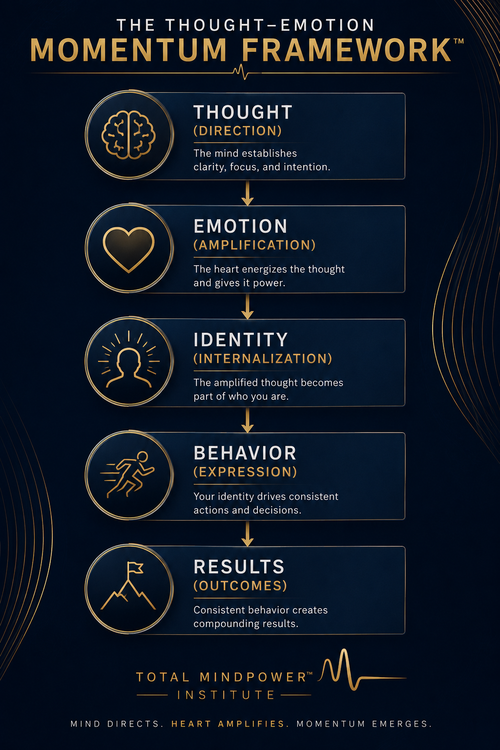
The Heart Is the Amplifier of Thought™
The mind establishes direction. The heart determines intensity.
Whatever you think about consistently — your heart amplifies. The emotion you attach to an idea is what transforms it from an abstract concept into a living force that actually shapes your identity and drives your behavior.
When you hold a vision and simultaneously feel faith in it, conviction about it, genuine purpose behind it — that emotion magnifies the thought. The vision becomes more real. More motivating. More capable of pulling behavior toward it rather than requiring willpower to push.
This is why two people can set the identical goal and produce completely
different results. Same plan. Same information. Radically different emotional relationship to the vision.
The one who moves is not more disciplined.
They're more aligned.
The Amplifier Works in Both Directions
Here's what makes this principle both powerful and urgent:
The amplifier is neutral. It doesn't choose what to amplify — it amplifies whatever is present.
This is where most high performers quietly lose ground.
You're thinking about growth — but emotionally rehearsing doubt about whether you can sustain it.
You're pursuing prosperity — but the emotional undercurrent is scarcity, a quiet belief that it won't last or that you don't quite deserve it at this level.
You're envisioning the next stage — but underneath, fear of exposure, failure, or irrelevance is running louder than the vision itself.
The heart doesn't judge the thought. It amplifies it.
So if doubt is the dominant emotional state behind your biggest goal, your heart is making doubt more powerful — not the vision. You end up working hard in the direction of what you fear rather than what you want.
This isn't a motivation problem. It's an amplification problem.
And it shows up as inconsistency, stalled momentum, and the exhausting sense that you're pushing rather than moving.
Emotional Stewardship Is Not Soft Work
When most high performers hear 'emotional leadership,' they dismiss it.
They're used to being the person who performs regardless of how they feel. Who pushes through. Who figures it out.
But emotional stewardship — the practice of recognizing what you're amplifying and deliberately directing it — is among the most advanced performance skills there is.
It's not about suppressing what you feel.
It's about refusing to let unconscious emotional states quietly undermine the vision you're consciously building.
The executive who can hold conviction under pressure, who can return to faith after a setback, who can feel the doubt and then choose which emotion gets amplified — that person has a performance advantage that no system or strategy can replicate.
Awareness creates choice. Choice creates influence. And influence over your own amplification is what determines whether a vision stays a vision or becomes a result.
What Alignment Actually Feels Like
When thought and emotion move in the same direction, something changes that's difficult to explain but immediately recognizable once you've experienced it.
Execution stops feeling forced. Decisions come faster. Persistence stops requiring the same level of willpower because you're not fighting your own internal signal.
You stop pushing toward the goal and start moving from the identity of someone already committed to it.
That shift — from forced to aligned — is what most high performers are chasing when they talk about wanting to be more consistent. They think it's a discipline problem. It's usually an alignment problem.
When the mind is clear on direction and the heart is supplying the emotional energy of faith, purpose, and conviction, momentum isn't something you manufacture.
It's something that emerges.
The Question Worth Sitting With
Your vision is real. Your capability is not in question.
But before you add another strategy, another system, or another push — consider this:
What emotion are you consistently amplifying behind your biggest goal right now?
Not what you think about it. What you feel about it, underneath the thinking.
Is it faith — or managed doubt?
Conviction — or quiet fear dressed up as caution?
Purpose — or obligation you've learned to perform?
Because the answer to that question will tell you more about your next six months than any plan you could build.
The mind establishes direction.
The heart supplies the power.
When both are pointed the same way — that's when vision becomes reality.
— E
Total MindPower Institute
Identity – Alignment – Execution – Results
Directional Identity Diagnostic
If you feel capable of more than your current results reflect, the Directional Identity Diagnostic can help you identify where greater clarity and alignment may be needed.
This complimentary assessment evaluates the relationship between your identity, direction, and execution to help uncover the patterns influencing your current results.
Next Step
Complete the Directional Identity Diagnostic and gain greater clarity about the next stage of your growth.
About the MindPower Journal
The MindPower Journal is the applied thinking publication of Total MindPower Institute.
It exists to help professionals build identity-aligned clarity, disciplined execution, and meaningful results through structured thinking and practical insight.